Just as I reached my annual apex of feeling overwhelmed by our self-created flood of produce and somewhat resentful of the time it demands and guilt it instills when so many are hungry, I stepped out of my world and into another for a day.
I spent that day listening to hundreds of people from all over the U.S. and Canada who deal with hunger, homelessness, health, agriculture, labor and other sectors where injustices are becoming more pronounced. It was the last day of a 3-day conference called "Closing the Hunger Gap," hosted by the Oregon Food Bank.
I knew I'd learn a lot, but the thoughts provoked by the people I met and listened to that day led to something more profound. My feelings are coalescing into anger. That's probably a good thing as we move inexorably into another election season that has as much substance as a vat of cotton candy.
From the breakout sessions I attended, I both regretted--and was glad--I had not attended all 3+ days of the conference. It would have been more overwhelming than my measly flood of produce and probably more than my brain could absorb - not because of negativity, but because of myriad inspiring conversations, ideas and keynote speakers. They coalesced the frustration I've been feeling for quite some time, but hadn't voiced with others. This was an opportunity for me, an outsider, to learn from people who deal with issues that are altering our communities and our country.
I suspect most who attended the conference would not be disappointed to find their work no longer necessary. Unfortunately, it's not likely to happen any time soon.
What You See and What You Don't
The "face" of the problem is the increasing homelessness in many communities. But that's more like the scab on a sore that's festering below the skin, unseen. We can ignore it or try to cover with "band-aids" to ease our consciences and make us feel better, but it does nothing to solve the problem in the long run. In spite of years of charity, the numbers are increasing. Is the help offered by armies of well-meaning volunteers and non-profits only exacerbating the situation by taking pressure off our politicians and titans of industry? The symptoms are being attended to but the root causes are not.
The visible homeless, with and about whom we feel most uncomfortable, are often those plagued by unattended mental illness or addictions. Surviving as best they can must only exacerbate the symptoms. A bowl of soup and temporary shelter in winter won't change their situations.
There are also "invisible" homeless all around us who show up for work and school every day. A shocking number of children in our own community have no real home; they may still be with one or both parents, but sleep in cars or constantly change locations (hotels, couches or floors of family and friends). They have no place to call home, let alone a room of their own in which to study or play or temporarily escape the fear and frustrations in their lives. How will that affect them as adults?
Universities now have food banks for students barely scraping by. Work-study jobs are designed to give them just one hour less than the number that would qualify them for employee benefits, saving the university money. However, that one hour also makes them ineligible for SNAP benefits (food stamps). Add this Catch-22 to the fact they'll likely graduate with debt they'll be saddled with for decades and their futures don't look as promising for having played by the rules and gotten an education as it did for previous generations. What does that portend for our future society?
Just as we judge all homeless by the most visible, we often judge all who use food banks as somehow failing as good citizens. Truth is, many of them work not only a job, but two or three, and still can't make ends meet because of high housing costs, a temporary or chronic health condition, abusive family situation or some other crisis in their lives. Why should low-wage earners who show up to work every day (they can't afford a sick day) feel shame in not being able to feed their families? Do their employers (especially those whose CEO makes millions) feel shame their employees need food banks? Are stockholders aware of it?
Situational or Generational?
Some who rely on food banks are infrequent users who feel shame in using them and thus avoid them. Many who qualify for SNAP (food stamp) benefits don't apply. Others are generational users for whom it is their way of life. They know how to work the system for their long-term advantage. We tend to judge the former by the latter, making their situation all the more uncomfortable. Hence, we rarely hear their stories. If we did, they might reveal more of the root causes of growing need.
In our increasingly global and investor-owned world, it's hard to put a finger on the root causes of food insecurity, lack of affordable housing, non-living wages and all the other injustices that are stewing at and just below the surface. There are many and they've been growing for a long time; the consequences are becoming increasingly visible and tangible. Our daily news shows where the scabs are being ripped off. The report may seem to be "just" about racism, health/obesity, labor strikes, housing starts, immigration, etc. but they are all related to access to jobs that pay a living wage, food, healthcare, housing, and education.
We were all brought up to believe that if you just get an education and work hard, you can achieve anything. It's still true for some, but an increasing number are exhausted from the treadmill that leads to nowhere. Someday there will be enough of them with just enough energy left to start a revolution to abolish the growing inequities - again. History does repeat itself and we must heed lessons from situations eerily similar to those in our history books. The civil rights movement did not settle racism, the women's rights movement didn't bring pay equity, wars have not brought world peace. Labor unions were formed when a few enjoyed great privilege and the masses got the crumbs. Laws to counter the inequities of the previous century have been steadily diluted to benefit the few again. Democracy can't be entrusted to the rich to dole out to the rest of us.
One day soon, the well-meaning folks will put down the bags of groceries they're carrying to the food bank or put down their ladles at the soup kitchen and join those in long lines at the doors to take to the streets to demand justice. We can't call ourselves a democracy when power and wealth is concentrated among fewer and fewer people while the rest see waning opportunity for future security.
Keynote speaker at the conference, Nick Saul, told the story of an event in Canada where a cabinet minister commented that the happiest day of the year for her family was when they shopped together for food for the local food bank. A recipient whose family had to rely on such food while she went to school and worked several low-wage jobs spoke truth to power when she said, "There is no justice when your children get to choose what my children eat." That recipient, Nadia Edwards, was also part of the keynote session, along with Janet Poppendieck. Nadia not only got a degree in social work and initiated new educational support programs in food banks, but returned to school to become a nurse with the goal of working on the streets with the homeless. She's been on that tightrope; she understands. But she won't just be applying band-aids, she'll be poking at root causes and speaking more truth to power.
She's both inspirational and revolutionary.
Wednesday, September 23, 2015
Friday, September 11, 2015
Parade and County Fair
For
a small town these were
quite the events.
People came from other towns, even friends and family from cities. It
was pure small-town Americana and the highlight of the summer for
kids in the 1950s.
The
Parade
Towns
still have parades, but they don't seem as elaborate. Or, am I
just remembering them through a kid's eyes? No, I don't think so.
The
main difference between then and now were the floats. They were
elaborate examples of excess and waste (through my adult eyes), but I
don't think anyone—least of all us kids—thought of them in such
terms then. They were beautiful and somewhat magical. People on them
threw candy to kids. Girls were dressed in formals and long gloves
(how hot those must have been!), others in costumes befitting the
float's theme.
The
excess was the result of the design and
size. Most were built on a
big flatbed truck or long, flat trailer, the kind used to haul huge equipment. Chicken wire was molded into
a form (rural scene, waterfall, covered wagon, church, etc.) then stuffed
with gazillions of colored paper napkins – all
told, the town must have gone through truckloads of them. Hidden
in large spaces, such as equipment shops, barns (near town, they
couldn't be driven too far or too fast or all the napkins would blow
out) or Quonset huts, it
took a week or more to build each one.
Part of the fun was
keeping them hidden while
the members of the given organization built them. Then, they'd be revealed the
morning of the parade to oohs and aahs. What a nightmare if it rained
or a wind storm arose, but I don't remember that ever happening.
Prizes were awarded and the floats stayed on display for a while
after the parade, then they were disassembled and big loads of
napkins would be hauled to the dump (it wasn't called a landfill back
then and recycling wasn't a word or concept yet). I
doubt much of the chicken wire was reusable after being stretched and
shaped either. It was rendered frustratingly unwieldy, but kids had no clue.
![]() |
| My brother's Boy Scout troop (Note small float behind them) |
Floats weren't the only things in the parade. The high school marching band (which often won top prizes in state competitions), Boy Scouts and American Legion drum and bugle corps marched. There were lots of horseback riders, and some kids decorated their dogs or brought pets in wagons.
![]() |
| Nieces and nephew ready for parade in 1980s |
One
wonders where all the creative ideas for floats and kids' costumes
came from in that era before the internet, Google, Pinterest and all
the electronic idea-sharing sources and photos. There were plenty, though, and it was great
fun to see it all in one big festival of our own making.
There were so many in the parade it's amazing there were people left to watch it in this town of about 2,000 inhabitants.
The Fair
You could find the fair with
your eyes closed, just by the unique aroma: a combination of greasy
hamburgers, cotton candy, manure and dill. And
dust. Afternoon winds would always stir dust into the mix.
Every kid with a dollar in his
pocket was in for a day of adventure, pop bottle in hand. Carnival rides and the 4-H barn kept most kids
entertained until the rodeo started. As at events today, service
organizations made money by selling food at booths - the
ones where you could get a hamburger or chili to counteract all
the sweet junk food.
![]() |
| My Dad & baby sis at the fair |
Adults and kids in Scouts, or who those had 4-H
projects that didn't involve animals, had entries displayed in the
Home Ec building, whence emanated the aroma of dill, displayed alone
or in a floral
arrangement. Ribbons were awarded – purple for grand prize, blue,
red or white. No one could see the last-minute panic behind them to
finish on time, short tempers of frustrated parents whose
procrastinating kids were up late finishing their projects. Many a
tear was shed. The swiftness with which that was all forgotten was
determined by the color of the ribbon (if one appeared) sitting
beside it at the fair in the following days. Promises
and determination to start earlier next year were as fleeting as New
Year's resolutions.
The more disciplined adults
entered beautiful needlework, picture-perfect loaves of bread, little
jars of pastel jellies or large ones of colorful fruits or
vegetables. Those were the most fascinating to me. How did they do
that? And, equally impressive, they grew
whatever was in the jar! About all I knew about canning at that point
was learning from 4-H or home ec lectures that it would be very
dangerous if you did it wrong. People could die from botulism. That
made it all the more mysterious and impressive. Little did I know
that I'd be doing lots of canning in the future.
Who knew that decades later I'd
be canning lots of home-grown produce every summer, but growing it too. I've never
entered anything in the fair since I was a kid, but the thought does
stroll across my mind almost every summer...
Monday, September 7, 2015
Thoughts During Harvest Season
It's curious that when I was growing up in a farming community on
the Great Plains in northeastern Colorado, where grains (wheat, oats,
barley, milo, sorghum, feed corn), sugar beets and cattle were the
main foods produced, I was little aware of it as “real” food. It
was all shipped elsewhere to be processed, never to be seen again –
or at least not recognized as something local when it came back to
us. Maybe I was too young to be interested, no one else seemed to be either.
The sugar beets went to a factory in the neighboring town, about 7
miles away. Some of them likely ended up in our grocery stores,
kitchens, school cafeteria and restaurants but there was no way of
telling. It all went under the name Great Western sugar, just like beets
from elsewhere. Still, I doubt many locals reached for bags labeled
cane sugar; they likely would have been loyal to beet sugar.
It was the same with grains. At harvest, farmers brought their crops
to any of three grain elevators in town, one of which my grandfather owned. When prices seemed good
(always a gamble), they were sold and shipped by rail to Denver.
There they were mixed with grains from all over the region and sent
to mills where they were processed into flour and returned to us in bags
labeled Gold Medal or Pillsbury. Bleached white flour was most commonly used; the
germ and bran were removed and sold separately. It never
occurred to me (or probably most anyone else, except perhaps the farm
families themselves) that some of the Wonder bread hugging our lunch
meat and mayo or peanut butter and jelly together came from a nearby farm.
A farmer friend here in Oregon said when his mother was a school teacher she realized that even some
of her students who lived on farms, whose families grew wheat,
didn't see the connection between wheat and bread. It's likely the same everywhere, or was more so back then. I suspect I knew it
intellectually as a kid, we would have learned it in school. But, it
sure wasn't what I was thinking when I put slices of bread in the toaster or made a grilled cheese sandwiche. Or, when we went to Grandad's elevator and he'd let us get a handful of wheat to
chew on 'til it turned to a chewy gum-like substance -
probably gluten.
Today we live in Oregon's Willamette Valley where the dominant crops
are timber and grass seed, but can name the farm behind just about
everything on our plates every day, including the meat, beans and
grains. In fact, I buy wheat and triticale directly from farmers and
grind it myself when making bread or pastries. It's
as far as you can get from
Wonder bread. White wheat (has less gluten so is used for pastry and
flat breads) grows best in this climate, but some red wheat is grown
too. White wheat, freshly-ground, makes excellent pie crusts and crackers –
ones you really taste because of the texture and flavor. Red wheat is what
was/is grown where I grew up, which is highest in gluten and used for
bread.
![]() |
| Not your grandmother's white bread |
Much of the produce we eat is from our own gardens and much of the seed for
that comes from local farms, or from seed Don saved himself. Farmers
where I grew up saved their own seed, selecting the best each year to
plant the following year. Today, not only is it discouraged, it's
illegal with proprietary seeds, especially genetically modified ones
(gmo). Fortunately, not everyone buys into that scheme and I buy from farmers who don't.
Harvest season today is very different. For one thing, I'm far more
involved in growing and preserving a good chunk of our food. As a
kid, I got to go out into harvest fields with friends to deliver
lunch to harvest crews and loved the whole dusty, hot, sweaty scene,
but then I didn't have to be out in it all day like those men and women, in open
combines and trucks – nothing to silence the noise or keep the dust
out of every pore of their bodies and clothes. One time when I was in grade school, my friend,
Jennifer, who was a year older than me, had to move a truck for her
dad and I got to “help.” We could barely see through (let alone over) the steering
wheel and I remember monitoring her progress by watching through a
hole in the floor.
Besides the grain elevator, Grandad owned a half
section of land. Rain and hail would often hit during summer and
could damage or destroy a crop within minutes. He
paced the living room on stormy nights, along with every
other helpless farmer. I realize now those storms affected everyone
since it was an agricultural community and all the businesses and tax
rolls depended upon a successful harvest.
Saturday Night
Summer
Saturday nights were lively in our town back then, especially
during harvest. This was before farmers had their own harvest
equipment so they relied on crews that went through all the farming
communities doing custom harvests. It
must have been a scheduling nightmare, given the vagaries of weather. The crews
were composed of high school or college-age boys and Mexicans who
came north specifically to work harvests. It was an
intense, exhausting season for all involved.
The downtown merchants stayed open late on Saturday nights then –
grocery stores, drug stores, clothing stores, the five-&-dime,
barbers, restaurants, cafes, bars, liquor stores, the library, the
Hippodrome theater, even car dealerships. Farmers and their families
came to town that night. So did just about everyone in town.
During harvests there were sometimes live bands in a Quonset hut near one of the grain elevators on Friday or Saturday night, where all the teenagers gathered. I worked in a drug store all through high school and remember Saturday nights being extremely busy. It was exhausting, but fun too.
Apparently it had been so when my
parents were in high school, as well. My Dad also worked in a drugstore during
high school and his boss, Mr. Cleveland wouldn't close the store "until the last
farmer left town,” Mom said. By then, it was too late for her to go out. She
said my grandmother, like many others in town, would park her car in
a strategic spot downtown that afternoon and walk home (only about 4
blocks), then come back in
the evening and have a prime spot to people watch and visit with
passers-by. That was what
people did on their front porches during nice weather – but the
“porches” moved downtown on Saturday night. No one had a television set then and computers and social media were the stuff of science fiction.
Today,
small farming and logging communities are but a shadow of their
former selves and not only are Saturday nights quiet, but most every night is. Farmers have their own harvest equipment, or have closer access to it when they need
it. Small hometown stores have been replaced by the Walmarts
and similar chain stores with lower prices, though people have
to drive to other communities to shop them. The internet has also
taken a toll since you can shop from home. Porches on houses today are more for looks. I never see
people sitting on them, visiting with passers-by, though some of the fancy houses even have nice wicker furniture on their porches. Community
organizations are fading, as well. We're "too busy" and connect more via a machines. We don't have time, we say. What
are we spending our time on? What is happening to “community”?
It's a question surely every generation has asked as their worlds
changed.
Sunday, August 30, 2015
An Embarrassment of Riches
Most every gardener feels it, especially by late summer: overwhelming abundance. Those tiny seedling that crowded the windowsills
in spring are feet high or yards long by now, producing more food than most of us can use or preserve. Friends, neighbors, co-workers and food banks share in the bounty. Fellow gardeners swap varieties and techniques while birds pluck seeds from sunflowers overhead. The ground is baked hard (even the recent rain won't change that much yet), so robins can no longer pull worms from it. Those wrigglers are buried deep or hiding under mulch.
Canning pots rattle throughout the land and freezers bulge. Dry, cool spaces are hung with garlic, beans, onions, squash, ears of popcorn and other foods that (mercifully) require no electric power or more of our time to preserve. Power bills are high in the fall from food dryers, canners and new freezers. Yes, it's a lot of work and I confess my enthusiasm for it isn't quite as strong as it was a couple of decades ago, but once I get started and see colorful, glistening armies of jars lined up on the kitchen counter, that old self-sufficiency glow is rejuvenated.
This is the true time of thanksgiving, when we have more than we can possibly use and think of those without enough food. I'm grateful not only for the bounty but for the space and ability to grow and preserve it. It seems every day the news proves we have less and less control over our lives. Growing food is one thing we can control to some extent. Mother Nature has a strong say in our success and even she has ratcheted up the challenge knob more than once, but that's part of the game and so far we've at least filled the larder and usually start each
season of preserving with some still left in the cupboard. That's our backup if or when an earthquake or fire or some other disaster visits our neighborhood - if it doesn't get destroyed in the event. It brings my late friend, Bunny, to mind. She said she was so proud the first year she had a big garden and canned dozens and dozens of jars of produce. Her husband built special shelves in their basement to store all the bounty. One night, they heard a terrible crash and went downstairs to find the weight of all those jars proved too much for the shelves and all that work lay amid countless shards of glass. She never canned again.
Don has taken over much of the gardening, especially the year-round part. I'm a fair-weather gardener and the years I did it all by myself (plus most of the preserving) were exhausting and I was always grateful when fall arrived and the
soil and I had a few months off. It was (and still is) so rewarding in the deep of winter to pull something from
the cupboard or freezer and get not only the taste of summer, but the aroma of it in the form of roasted tomatoes, basil, pesto, apple crisp, you name it.
We've eaten mainly local foods for the last 20 years since most of it came from our garden. Now, we can supplement with so many other local products that you barely have to put extra thought in creating mostly all-local meals. I know that's another thing to be grateful for - and
I am. My work has allowed me to meet most of the local farmers and interview them for stories or columns. The same with countless small food businesses over the last 35 years. What good fortune! Some of those food businesses are no longer around, others have been sold to other people or to larger businesses. Some celebrate milestones and get even better each year. Knowing all of these folks has given me insight into what it takes to build and keep a farm or business going. It makes what I thought was an enormous garden seem pretty puny (about 1/3 of an acre - I jokingly called myself a "fardner" when doing it myself - too small to be a farm but too big to be just a garden). If any of my crops failed I could go to one of them to buy whatever didn't work for me. Who could they turn to?
Just looking at our continuously full counter (in spite of preserving things daily) I/we have many, many blessings to count. May I never take them for granted.
![]() |
| Tomato seedlings on the window sill in the spring |
Canning pots rattle throughout the land and freezers bulge. Dry, cool spaces are hung with garlic, beans, onions, squash, ears of popcorn and other foods that (mercifully) require no electric power or more of our time to preserve. Power bills are high in the fall from food dryers, canners and new freezers. Yes, it's a lot of work and I confess my enthusiasm for it isn't quite as strong as it was a couple of decades ago, but once I get started and see colorful, glistening armies of jars lined up on the kitchen counter, that old self-sufficiency glow is rejuvenated.
This is the true time of thanksgiving, when we have more than we can possibly use and think of those without enough food. I'm grateful not only for the bounty but for the space and ability to grow and preserve it. It seems every day the news proves we have less and less control over our lives. Growing food is one thing we can control to some extent. Mother Nature has a strong say in our success and even she has ratcheted up the challenge knob more than once, but that's part of the game and so far we've at least filled the larder and usually start each
season of preserving with some still left in the cupboard. That's our backup if or when an earthquake or fire or some other disaster visits our neighborhood - if it doesn't get destroyed in the event. It brings my late friend, Bunny, to mind. She said she was so proud the first year she had a big garden and canned dozens and dozens of jars of produce. Her husband built special shelves in their basement to store all the bounty. One night, they heard a terrible crash and went downstairs to find the weight of all those jars proved too much for the shelves and all that work lay amid countless shards of glass. She never canned again.
Don has taken over much of the gardening, especially the year-round part. I'm a fair-weather gardener and the years I did it all by myself (plus most of the preserving) were exhausting and I was always grateful when fall arrived and the
![]() |
| Tomatillos ready to roast |
We've eaten mainly local foods for the last 20 years since most of it came from our garden. Now, we can supplement with so many other local products that you barely have to put extra thought in creating mostly all-local meals. I know that's another thing to be grateful for - and
I am. My work has allowed me to meet most of the local farmers and interview them for stories or columns. The same with countless small food businesses over the last 35 years. What good fortune! Some of those food businesses are no longer around, others have been sold to other people or to larger businesses. Some celebrate milestones and get even better each year. Knowing all of these folks has given me insight into what it takes to build and keep a farm or business going. It makes what I thought was an enormous garden seem pretty puny (about 1/3 of an acre - I jokingly called myself a "fardner" when doing it myself - too small to be a farm but too big to be just a garden). If any of my crops failed I could go to one of them to buy whatever didn't work for me. Who could they turn to?
![]() |
| The only things not local in this Nicoise salad Don made (with local albacore) is the salt, pepper and olive oil. |
Friday, August 21, 2015
Be Careful What You Wish For
It's not news to anyone that weather this summer has been extreme just about everywhere, at least part of the time. Here, in the Pacific Northwest, it's been exceptionally dry and hot. As predicted, wildfires are ablaze in every western state with resources stretched to the snapping point. The Okanagan Complex in north central Washington is the #1 national wildfire priority today. Firefighters from Australia and New Zealand are expected to arrive this weekend.
Tragically, three firefighters died near Twisp, Washington yesterday and others were seriously burned when they were trapped by fire. I don't know what those men and women are paid, but it's not enough. I can't even fathom the grueling work they face, without let-up, once a fire starts. This summer has been a particular hell for them. They must be absolutely exhausted, in spite of every comfort they are provided. Some train near here and I've seen the heavy protective clothing, helmets and packs which must make already extreme heat darn near unbearable. I try to imagine what must be going through their minds at the end of a long day (or night) or in the hellish thick of an uncontrolable fire. They have to wonder what the heck they were thinking when they signed on. Was it adventure they were after? A challenge? Money for school or family? Whatever it was, we should all be extremely grateful. It's work few can perform.
On Monday, one of the weather prognosticators that I follow said there's a good chance for some serious rain to visit us by the end of August or early September. It would likely begin as snow in Alaska and move down -- all the way to northern California, he said -- bringing rain, glorious rain to our parched world.
Yeah, yeah, we've heard that before, but it has yet to pan out. Still, I've pinned my hopes on it all week, telling everyone I'll be out dancing in it when it arrives.
But, today on Oregon Public Broadcasting's Think Out Loud, one of the reports made me feel almost greedy. Apparently, the cold front that would eventually drift south, bringing that glorious rain, would also wreak havoc with the wildfires, which are barely contained at this point. The cold air clashing with the hot air created by the fires would cause winds to shift quickly and unpredictably, creating even more hazardous conditions for firefighters and property owners. How could I wish for that? Would that inhibit the rain from falling there? Couldn't it help almost immediately thereafter? How scary weather is proving.
Oregon's biggest fire right now is the Canyon Creek Fire in southeastern Oregon - a very different terrain from the Willamette Valley, yet beautiful in it's unique way and home to amazing wildlife, especially birds.
I never used to worry much about wildfires in our forested neighborhood until the last couple of years when things started to dry out more. This year has been especially scary. What if this truly is the "new norm"?
About 20 years ago we converted about 4 acres of former cow pasture into a forest. It seemed like a much higher calling for the land at the time, but now I'm having second thoughts. Two summers ago we thinned quite a few, which left nightmarish piles of branches everywhere. The forester said they'd decompose within about 6 years, but I think that's under normal wet conditions.
I also trimmed countless branches from other trees on our property, about head height, making them easier to walk among and improving the value of the timber by reducing knot holes. This summer we've notice that the branches higher up have slipped downward, tapping or grabbing us as we walk through the woods. Is that in part because of the drought? Our neighbor pointed out there are fewer fir cones this year too. So many silent "messages" I wish a professional could interpret for us.
If there's a way for that rain to come and not worsen the already horrible situation firefighters are dealing with, that's what I wish for...
Tragically, three firefighters died near Twisp, Washington yesterday and others were seriously burned when they were trapped by fire. I don't know what those men and women are paid, but it's not enough. I can't even fathom the grueling work they face, without let-up, once a fire starts. This summer has been a particular hell for them. They must be absolutely exhausted, in spite of every comfort they are provided. Some train near here and I've seen the heavy protective clothing, helmets and packs which must make already extreme heat darn near unbearable. I try to imagine what must be going through their minds at the end of a long day (or night) or in the hellish thick of an uncontrolable fire. They have to wonder what the heck they were thinking when they signed on. Was it adventure they were after? A challenge? Money for school or family? Whatever it was, we should all be extremely grateful. It's work few can perform.
On Monday, one of the weather prognosticators that I follow said there's a good chance for some serious rain to visit us by the end of August or early September. It would likely begin as snow in Alaska and move down -- all the way to northern California, he said -- bringing rain, glorious rain to our parched world.
Yeah, yeah, we've heard that before, but it has yet to pan out. Still, I've pinned my hopes on it all week, telling everyone I'll be out dancing in it when it arrives.
But, today on Oregon Public Broadcasting's Think Out Loud, one of the reports made me feel almost greedy. Apparently, the cold front that would eventually drift south, bringing that glorious rain, would also wreak havoc with the wildfires, which are barely contained at this point. The cold air clashing with the hot air created by the fires would cause winds to shift quickly and unpredictably, creating even more hazardous conditions for firefighters and property owners. How could I wish for that? Would that inhibit the rain from falling there? Couldn't it help almost immediately thereafter? How scary weather is proving.
Oregon's biggest fire right now is the Canyon Creek Fire in southeastern Oregon - a very different terrain from the Willamette Valley, yet beautiful in it's unique way and home to amazing wildlife, especially birds.
I never used to worry much about wildfires in our forested neighborhood until the last couple of years when things started to dry out more. This year has been especially scary. What if this truly is the "new norm"?
About 20 years ago we converted about 4 acres of former cow pasture into a forest. It seemed like a much higher calling for the land at the time, but now I'm having second thoughts. Two summers ago we thinned quite a few, which left nightmarish piles of branches everywhere. The forester said they'd decompose within about 6 years, but I think that's under normal wet conditions.
![]() |
| Arthritic-looking droopy branches |
If there's a way for that rain to come and not worsen the already horrible situation firefighters are dealing with, that's what I wish for...
Tuesday, August 11, 2015
Sweet Revenge!
This has been a nasty year for yellow-jackets. Nasty for humans, that is, but apparently great for hungry yellow-jackets. Their populations multiply exponentially in dry springs and early summers. By mid-summer, they've taken over - and this year with a vengeance. Recently, while mowing our dandelion "lawn" (we let our grass dry out in summer), a yellow jacket got stuck in my shoe and stung like crazy when he couldn't get out. He was really ticked off. When I stopped "dancing" and hastily bent over to take my shoe off, two more under my shirt took umbrage with the move and let me know their displeasure. Now I was really ticked too!
However, while hanging out laundry yesterday, with yellow-jackets swarming and buzzing their warning, my eye caught something that made me happy. It was a Goldenrod Crab Spider on the side of the wasp trap hanging from the clothesline. She had just nabbed and poisoned a yellow-jacket with her powerful venom. It looked like she was "kissing" him. The wasp became motionless and she proceeded to suck the "juice" right out of his mean little body. "You go girl!" I shouted. Though the wasp's mates continued to harass me to the point I went inside, I kept sneaking back out to check on her, wondering if she'd nab more. There were plenty buzzing around the wasp trap she was sitting on (and blending with so beautifully).
First thing this morning, I went out to see if she was still on the wasp trap. Yep. She'd apparently spent the night on the black strap holding it onto the line. As the day progressed, she moved first to the top of the trap, then down until I thought she'd given up and left. But,no! The clever girl had moved to the bottom where the wasps enter the trap. I never did see her catch one today (and checked frequently), but hope she nabs one tomorrow. She's in the perfect spot to do it and blends in so well with the trap, I'd be surprised if the wasp saw what was coming.
According to the various websites, Goldenrod Crab Spiders can move backward, forward and sideways. They don't build webs, but hang out in flowers where their prey show up (flies, bees, wasps). I'm not happy to think of her nabbing bees - they're the "good guys" and we've got lots around here. She's welcome to all the yellow-jackets she can eat, though. Apparently, they lay eggs in a leaf, fold it over and secure it with their silk, but the mother dies off before the little ones hatch, so they're on their own. It can be a cruel, but very interesting little world out there.
![]() |
| Goldenrod Crab Spider (credit: Bugguide.net) |
![]() | ||||
| Sucking the life out of a yellow-jacket. Yum! |
![]() | |
| Hungry spider coming out of her hiding place at the end of the day |
Thursday, July 30, 2015
My Earliest Travel Adventures Across State Lines
Have you ever
unexpectedly happened upon a taste or smell that immediately
catapults you into a time warp, back to your childhood?
That happened to me one day as I was picking raspberries and popped one into my mouth. Something
![]() |
| It's a jungle in there! |
The Odd Details One Remembers...
Aunt Florence
(actually, my great aunt; she was my grandmother's older sister) and
Uncle Walt had two sons around my mother's age who had moved on to
their own lives. I guess Aunt Florence enjoyed having a little girl
around for a change. I'm not sure Uncle Walt was so hot on the idea.
A small, quiet man with rimless glasses and a dark, weathered face and arms, he kept his nose in the
newspaper in the evenings and his ear on the radio, listening to
baseball games. He wasn't the friendliest man, nor much of a
conversationalist, but he wasn't unkind either. He worked for the Union
Pacific railroad and left early every morning in dark denim work
clothes, a black metal lunchbox and Thermos of coffee under his arm.
He'd ease their black sedan from the little detached garage on its
two cement tracks into the street, then would disappear until evening. He'd come home tired and not as eager to hear about my day as I thought he should be.
I was put on the
train each summer, starting at the age of 5, to travel from our small
town in northeastern Colorado to Kearney, about 180 miles away. It's
hard to imagine parents doing that nowadays, but it seemed safe
enough back then. I wasn't afraid. There was always a grandfatherly
porter dressed in his deep blue Union Pacific suit and cap to tell me
how many more towns before we got to Kearney and made sure I got off
where Aunt Florence was waiting. Those gentlemen were kind enough not
to laugh when I asked if they knew Uncle Walt since he worked for the
railroad too. Some would pause, look pensively at the ceiling and
say, “Hmm, no, I don't believe I do.”
My Mom or grandmother would pack a little carry-on case of goodies to entertain me during the trip. In it were my Ginny doll (Barbie wouldn't appear for another few years, sparing my malleable psyche from the impossible body-type she indicated we were to strive for), some new clothes for her that Gram had made, a peanut butter & grape jelly sandwich (Gram always used cold butter so there were thick squares of it on one of the slices of white bread, with crust, cut diagonally), orange jellies shaped like orange segments and coated with sugar, Fig Newtons, potato chips, plus picture and coloring books. I couldn't wait to get on the train so I could see what they had packed; it was part of the adventure.
Aunt Florence and
Uncle Walt lived in a three-story house in a middle class
neighborhood. She and I walked everywhere since Uncle Walt had the
car. In those days, ladies her age,(in her 50s), didn't wear pants or shorts. She was always in a dress, stockings and sensible medium-heeled shoes, as was Gram. She looked serious, but had a slightly ironic smile and was fun to be around. She always had good ideas of things for us to do. If she drove, it was only on Sunday when she and I went to the
brown brick Presbyterian church downtown. Afterward, we would go to the dairy
across the street from the church and get several kinds of ice cream
made right there (the local precursor to Baskin-Robbins). They had flavors I'd never heard of, like pistachio, blackberry walnut, mint
chocolate chip and peaches and cream. When we got home, we'd make ice
cream balls, wrap them in waxed paper and fill the little ice box
freezer with wonderful treats to enjoy after supper.
There were things
to explore in the sons' rooms, one of which I slept in: adventure
books and magazines, a Boy Scout manual, comics, baseball gloves,
coin collections – all “boy stuff” and very boring. Across the
hall, though, in a closet at the top of the stairs, were boxes of old
clothes and jewelry I was allowed to play with. I was transfixed by
an amber necklace and bracelet. The dark-honey translucence were
magical. So, too, were the patterns of little black and white tiles
on the bathroom floor at the other end of the hall. There was plenty
of natural light streaming in from wood sash windows dressed with starched white
curtains. The claw-foot bathtub seemed enormous. The toilet had a
ceramic black and white handle. The doorknobs were clear glass. A
kid would notice those things since they were at eye level.
Downstairs, on a
shelf between the living room and dining room, was a white ceramic
cow cream pitcher. His tail curled up, forming the handle. There was
a hole in its back for the cream, which was poured through his snout.
(Gross, if you really think about it; but I didn't then.) Cereal
always tasted extra good when the milk came from that pitcher. The milk was delivered in bottles with a glug of
cream at the top, to a wooden box on the front porch early
mornings twice a week, along with other dairy products if you wanted.
About a block away
was a little grocery store blending nicely into the neighborhood. It
looked like it had been a home once too. The basement must have
served as the storage area, since customers had to climb steep wooden
steps to the first-floor store. A heavy screen door with a metal
center plate embossed with an ad for Pepsi Cola slammed with
authority behind you upon entering or leaving. Stepping inside, you
were enveloped in the aroma of indiscernible produce –
a mixture of bananas and onions, cantaloupe and cabbage. There was,
of course, an ample display of candy to entice the neighborhood kids
when they got their allowance or had change remaining when running an
errand for their mothers.
A big city park
within walking distance was like an enchanted forest. We had a nice
park in our town too, but it didn't have so many huge, shady trees
bunched together like that. Or the small buildings painted dark green
where maintenance equipment must have been stored. Others were restrooms with showers where you
could change clothes to go swimming. There was a big, round cement
wading pool for little kids and a
bigger one with diving boards, surrounded by a chain link fence, for
the big kids.
One day, when Aunt
Florence and I were at the wading pool, a woman screamed and ran into
the pool in her clothes to grab a child who was face-down in the water. A couple
minutes later, Aunt Florence insisted we leave. She assured me the
child would be OK but we needed to get out of their way. I tried to look back as we left, but she tugged me along. That
evening I heard her telling Uncle Walt and talking softly on the phone with
someone. Her tone of voice and sad expression told me the child
wasn't OK, but we never talked about it.
This was the era
before air conditioning in homes so most hot summer days kids
gravitated to parks and pools, usually on their bikes with a round
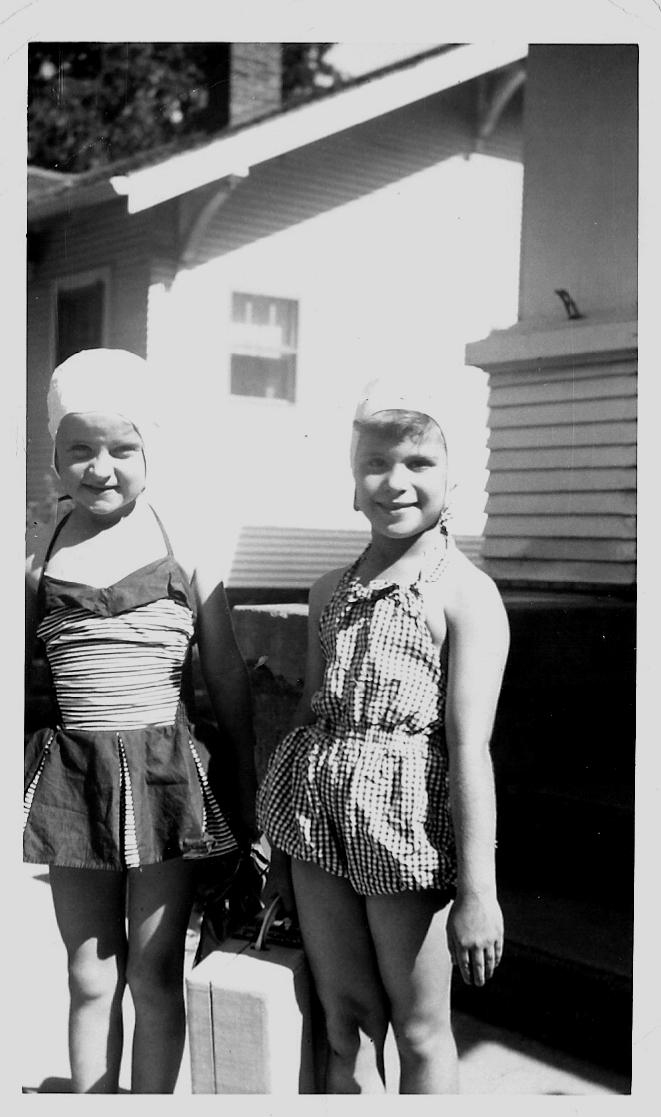
towel under their arms, flesh-colored nose plugs hanging around their necks. Girls had to wear swim caps. They were ugly,
hot things and I never understood why boys didn't have to wear them
too. We kids smelled like chlorine most of the summer and our bodies
ripened to a bruised-peach brown and our hair turned lighter.
At night, Aunt Florence and I would take walks, sometimes to the Dairy Queen near the college. Radio and sometimes television voices and laughter emanated from the houses we passed. One year there were swarms of cicadas. The din was a louder version of the natural ringing older people hear when there is no other sound. Thousands of empty shells clung to trees and houses or crunched under foot as you walked on sidewalks or lawns.
![]() |
| Chris & Bonnie head to the pool. |
The End of an Era
The trips to
Kearney ended after a few years. Then, I biked to our town's pool every
day, or out for picnics along irrigation ditches at the edge of town
with a friend. The trips to Kearney, though, made a big impression on
me and may have sparked the itch to travel that grew stronger as I grew older.
Passenger
trains are long gone from our town, replaced by countless freight
trains day and night. Walkable cities with neighborhood stores are
being considered again. It's refreshing to see kids on bikes and
playing outside, though it's often at day camps these days, where
activities are organized and supervised.
Kids who travel today don't need a case full of distractions – they have phones or little devices to play all kinds of games - pocket-sized "toys" to keep them amused for hours on end, just like their parents.
Subscribe to:
Posts (Atom)