Tuesday, June 30, 2015

Lessons I'm Learning

      If we've learned anything over the last 35 years living in the country, surrounded by woods, it's that we are part of a very complicated web - a fascinating and sometimes frustrating web. Each year the cohorts in this web teach us something new, including new skills.
      For example, the birds have taught me how to wrestle with bird-netting. I hate the stuff. It's worse than a pile of a coat hangers. And I hate some of the birds because of it. Especially the robins.
Culprit!
The blue jays too, though mainly because they're just noisy bullies.
      But, I have to remind myself that they earn their keep in other ways, like eating bad bugs. At least the robins do – not sure about the jays. I offer temptations and they're quick to partake - thank you very much.
      I can confirm that robins love berries, at least some kinds: strawberries, blueberries and gooseberries, for sure. They like others that I haven't planted, such as currants and cherries. They used to love my elderberry too, but I dug it out. Sometimes they get the chokecherries before I do. But, oddly, they don't like raspberries so we don't have to net those. Everything else we do. Well, except the rhubarb. They don't like that either.
     
No netting! Just the side fence. 


Today, I took the netting off the biggest strawberry patch, which takes as long as it does to put it up. It's been a great strawberry year, but they're slowing down with the heat. Fine with me. With all that danged bird netting, picking them is backbreaking. You have to hunch down and/or crawl around, trying not to squish berries in the process. We got plenty. The birds can have the puny few left.

     Meanwhile, I'll be trying to get into the blueberry cage gracefully. Once in, it's fine. We've rigged it up so you can actually stand up and walk around. Bliss!
White string holds netting down around blueberries on either side of funky "door"
       I haven't figured out how to make a good entrance to fenced/netted spaces. Maybe because I'm too cheap to invest in a truly elegant door or gate. I'll have to think on it and maybe figure out something better. No matter what I use, bird netting will catch on it. Guaranteed. And clothespins used to hold it in place will too. Need to raise your blood pressure? Just open a package of bird netting.
    
    The birds taught me not to leave loose netting around the edges of the berry cages because inevitably one will get caught and not survive if we don't see it to release it. So, I spend a couple of hours “sewing” the sides down with string (and unsewing when I take them down). Also, they can find the smallest opening they'll fit into - and within minutes of putting the netting up. Truly amazing.
     We have to take the netting down at the end of the season since we learned the hard way that snow and ice will pull anything down left up in the winter – even when we tried using chicken wire as the “roof” for the blueberry cage. Ice even pulled the clothesline post right out of the cement base once!
     
Elmer Fudd's "wabbits" visit here too
What the birds don't go after, something else will. Our garden, about 1/3 of an acre, is fenced against deer and has worked pretty well. No sooner had I got that up years ago and was feeling pretty smug, the rabbits taught me that they could get in – no problem. Rats. So, I put a much shorter chicken-wire fence around the perimeter. It helped for a while, but they learned how to jump above it (I swear it's a new Olympic sport) – or where there are depressions under the fence. So, Don puts wire on much of what he plants, especially the starts, to keep the bunnies and the birds away. Works fine, but then there are the slugs, symphylans, grasshoppers, flea beetles, aphids, bean beetles... It's an unending education.  And the garden is anything but aesthetic.
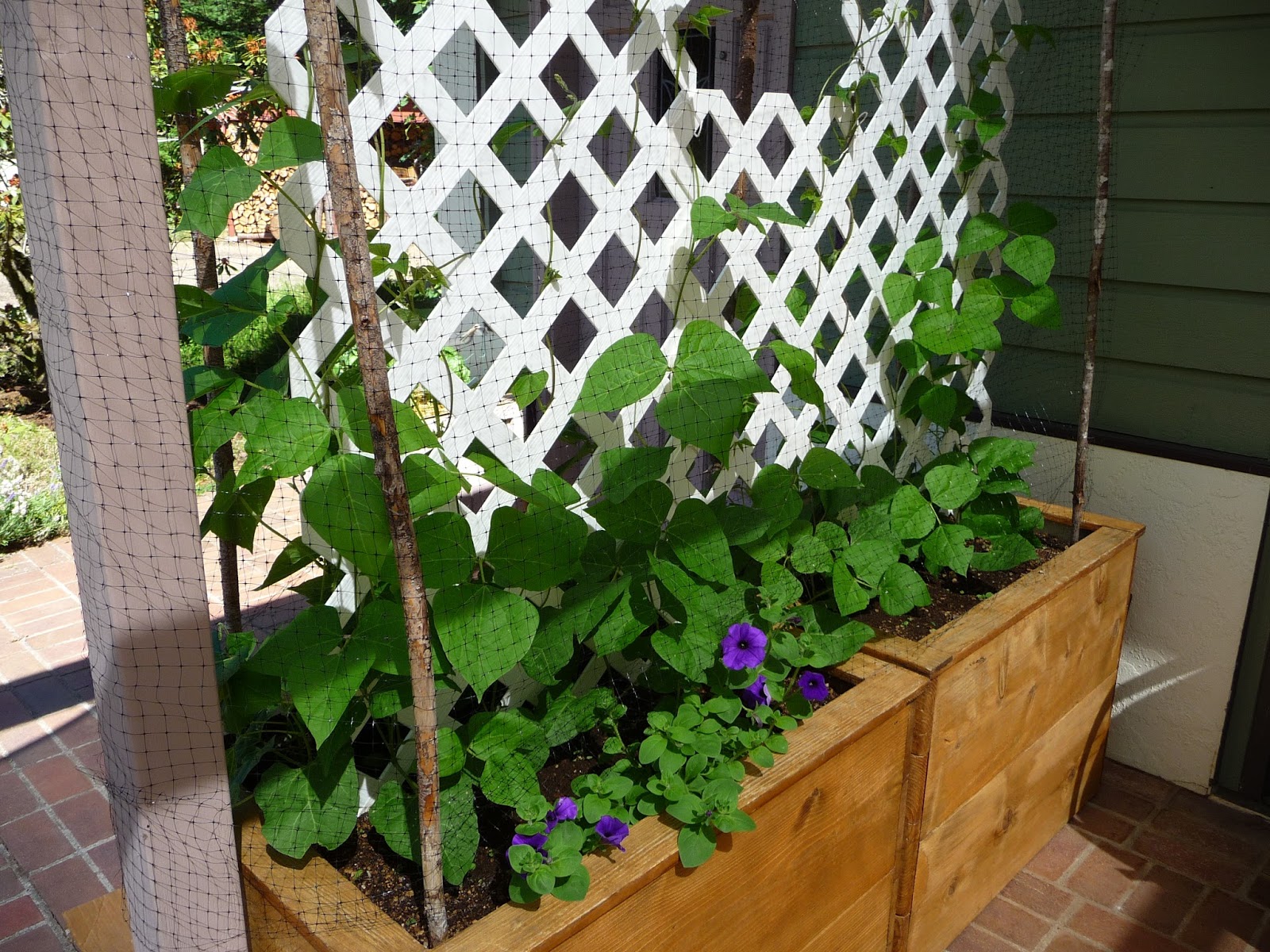
Young runner beans will soon consume the trellis


The deer leave most of the flower garden in front of the house alone because they've taught me what they don't care for. However, they do love the runner beans we plant on our front porch to create "walls" of shade, so those get netted too (sigh). But it works! The hummingbirds and butterflies can still get to the beautiful red flowers when they blossom.


The only fence the hops need is one to climb, and this isn't tall enough, but they make do. The lavender in front is buzzing with bees all day long. Soon, they'll move to the hop flowers. Lavender and hops are both used to make you relax - no wonder the bees like to sleep here!


 The hop vines are so rambunctious they're starting to take over one of the wren boxes. Maybe it will help deter the bully blue jays...

The garden is a great place to sit and meditate - if only there were time, and not so many critters to out-fox!

Friday, June 26, 2015

To Market, To Market - Again

     Shadowing Tom Denison at the Beaverton Farmers' Market in early May was such an energizing experience that I told him if he's ever desperate for a helper, let me know. Well, he was pretty desperate last week, having run through his list of eight subs with no luck. So he e-mailed me. Once again, I set the alarm for 2:20 a.m. and we left his farm by 3:45 a.m. in a fully packed truck. Just before leaving he opened the back to add one small cooler but there was no room.
     
Tom, Phillip and Joey setting up the display


As before, it was an inspiring, if exhausting, experience and renewed my appreciation for farmers' market vendors, their crews, and the workers in the fields who plant, nurture, harvest and fill those hefty tubs of gorgeous produce.
      One of the best parts of both market experiences was the trip up and back, about 3 hours all told, during which I could pepper Tom with myriad questions without interruption (an interviewer's dream!). His responses not only illustrated his passion for his work, but the complicated web of food production we rarely see or think about.The key word is "web."
      We've all seen those illustrations where a deep “slice” of earth reveals all of the levels of soil, sand,
rocks, insects, snakes, worms, rodents, water pockets, roots of grass and plants we see above the soil – you get the picture. Well, as Tom described the various aspects of farming, from the compost, cover crops, soil
Ready for the signs to be created
tests, fertilizer types and application methods, water sources, irrigation, weather, seeding, transplanting, predators (insects above and below the soil, birds, voles, gophers, etc), potential for molds, mildew, and crop failure for mysterious reasons, I realized how many life sciences and how much chemistry are involved and the countless decisions that must be made daily - even hourly - when  you work with perishable crops, human beings and fluctuating markets. And that's just getting the foods in and out of the ground! Once harvested, it needs to be cleaned, trimmed, sorted, prepared for various markets in boxes, totes or bags, depending on destination and storage requirements.
     Then there's the whole matter of working with crews, records (employee, payroll, certification, crop rotations, orders, etc.), scheduling people and deliveries, fulfilling orders, answering—or getting answers to—questions, researching everything from seeds and plant stock to whatever is necessary to keep them healthy until harvest, equipment, supplies, regulations, and on and on. Whew!
      And we all show up at the farmers' market, a somewhat festive atmosphere, in our “Saturday moods,”  assuming it's just as much fun for the vendor. We give nary a thought to the hours required to harvest and prep the produce, getting the stall set up (a good 1 1/2 hrs. of heavy lifting, decisions, arranging, sign-making, etc.), cashiering and restocking for 4 to 5 hours during the market, then the take-down, repacking, cleaning up your space and going home to unload, deal with the money, pay the crew, refuel the truck,wash display cloths and aprons, fix, replace or refill whatever needs it, respond to that list of questions accrued during the day and, hopefully, remember what your name is at the end of it. 
     Tom's wife, Elizabeth Kerle, organizes the crews for several markets, does at least one market a week herself, often two, manages 300 CSAs boxes and customers, the website newsletter, and, like Tom, needs to know what each farmers' market will expect to sell. Unfortunately, it allows little time for her acupuncture practice though I'll bet she sees plenty of need for it just on the farm.
A "canyon" of beautiful berries. An excessively hot day could turn them into 'solar jam'.
 Sizzling Temperatures
   This weekend, as the heat swells to triple-digits in our second heatwave (just in June), my thoughts are with the field crews getting all that produce picked and prepped in the heat for several markets (and other customers), and the market crews keeping it fresh for us. Such extreme temperatures require a whole 'nother level of worry over plant protection, watering, harvest impact and employee safety.
      We, of course, have the choice of whether or not to venture out in the heat to buy it. Whether we do or not, a lot of people have worked hard to be sure it's there and lookin' good, just in case we do.
      Food is ready to harvest when it's ready to harvest. If we truly support local foods, we need to be extra supportive during weather extremes. If the produce doesn't sell, especially the easily perishable foods, it will go to gleaners or soup kitchens that will move quickly to use it immediately. Or, it will be composted. Compost is a good thing, but think of all the resources that went in to producing the food in the first place.
      Cool thoughts to all you farmers, farm workers and farmers' market vendors in this exceptionally hot summer!

Thursday, June 18, 2015

Community Garden and Produce Update

      I was at the Calvin Community Garden by about 6:30 this morning. What a delicious time to be in such a lush and beautiful place – and I had it all to myself. Well, except for the birds out for breakfast.
I saw one snatch a flying bug mid air!  Of course there were bazillions of unseen critter crawling or slithering amongst the greenery - slugs, spiders, cucumber beetles, worms and only an entomologist would know what else.
     Speaking of slugs: I mentioned in a previous post that they always fall for (into) beer traps. Some of us, though, noticed the beer was gone but no slugs. A neighboring gardener figured it out when she saw the neighborhood cat slurping it up!
Wall-o'-waters about to go


      It was time to take the wall-'-waters off my eggplants and mulch the potatoes some more. The weather seems to have settled into warm enough nights that they'll do fine. Mine have been "babied" with the water walls (which soak up heat from the sun during the day, maintaining a little greenhouse at night with the warmth).


   But first, I wandered through the garden to admire plant progress and the ingenious contraptions people have erected to support the more exuberant ones, or climbers. I was struck by how many tomato cages are represented: round, square, octagonal, mostly out of wire, but some wooden ones too.
 
       These are great - they can be folded flat at the end of the season for much more efficient storage.  Clever!      
                                                       
These wooden ones look like they've got years of experience!
                              

      I'd never seen octagonal tomato trellises until this morning. They look super sturdy. This gardener will have several wheelbarrows full of tomatoes and peppers before long. Note the basil next to them - oh, the mouthwatering the dishes that will come of the mix!


Kathy was successful in growing cukes on this trellis last year.
    A variety of trellises for peas, beans, even cukes and squash dot the plots. Some are homemade from sticks or metal poles, others cut from metal fencing or grating. My neighbor, the Master Gardener with all the gorgeous flowers as well as produce, grew cucumbers up this trellist last year as an experiment. Worked great - the weight of the fruits pulled them downward through the holes for easy picking. She said she thinks the nasturtiums fended off the deer with their strong, peppery flavor and scent. Would love to believe it and will try them with my beans. Stay tuned...


One ambitious couple constructed a beautiful structure of three horizontal pieces of bamboo supported by bamboo posts and strung with strings for tomatoes and I'm-not-sure-what-all-else to climb. It's a work of art, though my photo doesn't do it justice. And bamboo fits so perfectly in a garden.  


Several people have artichokes – those gorgeous plants that remind me of a Broadway musical, such as Auntie Mame, with the star in some fancy dress, belting out show tunes.


We've gotten “reminders” from our beloved garden coordinator, Doug Eldon, to keep paths clear, plots weeded, water OFF when you leave, and no more forests of sunflowers. Hmmm...it's a little late for that, much to the birds' delight (come fall). I'm guilty of blocking a path (unintentionally) with potatoes that are growing out instead of up. Oops; sorry, Doug! 
     I saw some corn plants about an inch from the path. That happens easily since seeds are so tiny, it's hard to imagine how big they'll get. We'll need to elbow through that path soon enough.

      AND we forget how much food one tiny little see can produce! To look at a teeny tomato seed, you'd never think it will give you buckets and buckets of tomatoes before you know it. Same with lettuce and just about anything else you start from seed yourself. The only things that even hint at size might be squash or corn seed. Still, it's hard to imagine the wheelbarrows full of them you'll see in due time.


Speaking of wheelbarrows, my sweet gardener husband harvested one full of favas the other day, then brought them in to pull the bean pods from the stem in 3 large bunches, one after the other. Then came my job: shelling, blanching, freezing and/or cooking the beans. I leave the “jackets” on all but the biggest ones now, but it's still hours of work.


  Plus, it's only June and they're competing for
A bumper crop of strawberries  - some here with the "Berry Spoon"
my time with strawberries and a gazillion other garden tasks. I keep reminding myself how grateful we'll be come winter and can pull some “summer” from the freezer or pantry. In fact, I just gave my sis-in-law a birthday present of a jar of walnut butter from walnuts we gleaned with our neighbors from a huge, old tree a few miles from us last fall. It's the best nut butter ever. Plus a jar of rhubarb-ginger jam. You can't buy those in very many stores – and not homegrown and homemade for sure!

Wednesday, May 27, 2015

Living with a Compost Toilet

      Anyone who owns a house, farms, or raises a garden faces numerous seasonal chores that must be done when the weather is right.
      One task on our list is found on few others: cleaning out the compost toilet. It's an onerous task because of the design of our house as much as for the task itself, a flaw we can blame on no one but ourselves. Most other households with a year-round compost toilet (c.t.) have a basement, making access to the heart of the operation much easier. Since we don't have a basement, one of us must slither down into a pit under the bathroom floor we dug just big enough to hold the big c.t. “container” and an anorexic elf. My tall, slender husband assumes that acrobatic task while I hover above hooking hoses and running “honey buckets” to the outdoor finishing compost hole.
Downstairs c.t.
     It's outdoors where, in one last frenetic orgy, fat worms who've traveled in said buckets gorge themselves into oblivion, expiring in their own castings (a.k.a. “poop”). The final result the following year is a rich compost my flowers and ornamental plants love.
      The worms end up serving a much higher purpose than we larger mortals do. Upon death they are recycled into soil and nutrients, then are absorbed into flowers and plants. The seasonal process is repeated ad infinitum. It begs the question: why don't humans do the same? We are beginning to through “green burials” - a fascinating topic, but for another blog.
      Human waste, once used as fertilizer (called night soil, and still is used in some places) is treated in the U.S. as something from which we must be protected. In fact, the more advanced the culture, the more its human waste is likely to be managed right out of usefulness. There are, of course, good reasons for caution – fatal infectious diseases not being the least of them. As often happens, though, in our attempt to control the nature that sustains us, we go overboard and squeeze a link in the chain too tight. We fail to see ourselves as part of the greater cycle.

Upstairs c.t.
    Flush toilets and municipal sanitation systems are one example. That's not to say I think they should be done away with altogether. Compost toilets would be impractical, and probably unhealthy, in hospitals or large public or commercial buildings. But, as more people recycle their own kitchen, yard and garden waste through compost piles, those who wish to take their household cycle a step further should be encouraged to do so through compost toilets.
      In fact, the current drought may encourage more people to consider them. When we built our house and installed our c.t. about 35 years ago, they were very rare, though I've heard of at least a couple of others in our community. Today, you can find them at big box stores or via the internet, from little ones intended for occasional use in summer cabins to permanent year-round ones like ours. The better ones are fashioned after the Clivus Multrum . Ours was designed and built by a fellow in Cottage Grove and I remember heads turning in vehicles passing me and seeing people pointing and mouthing “What's that??” as I brought it home in the back of our pick-up. It looked like a little tugboat.
      An old-fashioned flush toilet can use anywhere from 5 to 7 gallons of water per flush (gpf). And when the plug doesn't descend correctly, water can run continuously, especially when no one is around to hear it. Newer ones, especially those with EPA WaterSense certification sip as little as 1.6 gpf. Some of the newer models I've experienced work well, especially those where you can choose a lighter or heavier flush, and others not so much. In fact, it often requires more than one flush to complete the task. Not very efficient.
      Compost toilets are not for everyone. I knew that even before we installed ours. Guests' reactions range from carefully avoiding the need to use it (perhaps thinking we race in as soon as they leave to see what they “did”) to thinking out-loud how they could include one in their own house.
     I used to worry what people would think of it. Now, I wonder if they worry what I think when pressed to employ the flush version in their homes.
     Yes, the c.t. can be odoriferous on occasion. A fan solves the problem. A solar-activated one serves during daylight, otherwise we start it with a manual switch when needed. Also, we sprinkle peat moss in regularly, especially when a “flush” would be appropriate.
     The greatest smell comes during the clean-out, naturally. People who wrinkle their noses at the thought might do well to consider that their own”waste” stinks too, but they make it disappear by flushing it. Rarely do we give thought to where it goes from there. A visit to the municipal water treatment plant would be enlightening.
     Toilet compost is supposed to be safe for use on your vegetable garden, but even I am reluctant to do so. Besides, we have enough kitchen/garden compost for that. Instead, the c.t. compost feeds our abundant landscape.
Some of the flowers and ornamentals that love c.t. compost
If you've considered installing one, you have far more information and choices available than we did way back when and I encourage you to at least read about them. For years, I had a nagging feeling we were a bit “backward” having an indoor-outhouse and have heard all the jokes, thank you. Now, with people more aware of resources and our environment, it feels like we might have been ahead of our time. Who knows. At least we can feel good about the bazillion gallons of water we've not used over three and a half decades.

Sunday, May 3, 2015

Before Dawn at the Farmers' Market

    The full moon glinted off neat rows of black ground cover and added ghostly illumination to dozens of white greenhouses as I arrived at Tom Denison and Elizabeth Kerle's farm at 3:30 a.m. The market truck was loaded and ready to head to Beaverton's first summer farmers' market (they'd done six winter ones between February and March). Tom and I climbed up into the truck cab and headed out. Elizabeth, a licensed acupuncturist in Corvallis, would be in a training in Eugene all day. Normally, she'd be working the Corvallis Saturday market, which she organizes, along with those in Salem and McMinnville.
     The  moon tagged along on the inky horizon as Tom drove, but was blotted by street lights when we arrived at the market site (a public parking lot across from the library, next to a park) about 5:30 a.m. We were the second truck to arrive. Tom jumped out of his cab to visit with the couple in the other truck. The friendship cultivated over decades of such mornings was evident in the easy banter, teasing, laughter and discussions of topics only a farmer could understand.
     Shortly, an army of similar trucks appeared from the empty streets, seemingly out of nowhere, but actually from the Willamette Valley and as far away as the coast, eastern Oregon and eastern Washington. The circle of visiting farmers grew as people emerged from the trucks, hugged and caught up on news. Few trucks had logos, but everyone seemed to know which one belonged to whom as it pulled in.
     The two women managers gave the signal and everyone eased into their spots to begin set-up and unloading. Tom quipped that one of the managers, Ginger, was perfectly qualified for the job. "She has degrees in food science and primate behavior," he said.
     As magically and quietly as the army of trucks appeared, so did Tom's Beaverton market crew, right on time. All live in the greater Portland area and arrive by a smorgasbord of transportation, from bike, bus/skateboard, zip car or their own. Some carpool. Most have been with Tom three years or more; one, Regina, lived and worked on Tom's farm when she was in school and served as a nanny for their son. You'd be hard pressed to find a nicer group of young people. They obviously enjoy the work and each other and love the food they are surrounded by most of the day. Their resulting healthy diets contribute to their constant energy doing set-up, moving heavy totes and equipment and taking everything down at the end of the day.
   The word "choreography" came to mind as the canopy posts were pulled from the truck and laid out, then connected, the canopy draped over the top, and all hoisted, appropriately enough, like an old-fashioned barn-raising. Tables came out next and arranged with frequent glances at the map Tom had prepared for their placement and what they'd hold. Occasionally a crew member would suggest something different. The respect Tom gives their ideas, usually agreeing with them, proves the quality of the team is as high as that of the produce they'll be selling within a couple of hours.
Joie and Chris set up by street lamp and the hint of sunrise.
     
    Once the tables are in place, displays are built up with empty totes, boards and fresh tablecloths.  As totes are opened and mounds of produce mushroom, you'd swear it's mid-summer by the aromas of strawberries, basil, garlic and young bunched onions. Those without such enticing aromas make up for it with bold colors: carrots, red onions, peas, chard with colorful stems, lettuces as big as your head, sweet onions the size of baseballs, deep green zucchini (yes, zucchini and strawberries in early May! Remember those greenhouses illuminated by the moonlight?) and muscular fava beans.

Vyasa creates some signs


 Some of the crew have artistic talents, showing not only in the gorgeous displays they create, but the excellent blackboard signs they do each week, according to what's available. Perfectly legible - an amazing feat in this age of daily keyboards!


Joie "supervises" Jakob and Vyasa's sign work
 
     At 8:00 sharp, someone walks through the aisles, ringing a bell to indicate the market is officially open. Within seconds the first transactions are completed by eager customers. At the Denison Farms booth, the mounds shrink as produce flies to the cashiers, then into myriad types of shopping bags and baskets.
     Tom's agile crew deftly restocks and also morph into cordial booth hosts and cashiers, gladly sharing their knowledge of the produce and how to prepare it. Some farm themselves, others garden and/or work in produce departments. They know their stuff because they eat it themselves. Every day. They love to trade or buy from other vendors throughout the day. Many enjoy lunch from a Lebanese vendor, Kombucha from another. Around noon, Regina offered me one of Tom's carrots to scoop in some goat chevre she'd traded with a nearby vendor. I honestly couldn't tell which was better - the sweet crunchy carrot or the cheese. Each complemented the other perfectly; the result was better than anything you'd get in a 5-star restaurant. Sublime sweat equity!
Produce about to do a disappearing act. David in background.


Vyasa, Jakob & Joie making signs in background


       Not surprisingly, nary a single berry made the return trip to Denison Farms. However, plenty of customers vowed they'd be at the market much earlier next week.
     The aroma alone of these berries, originally domesticated in France, now bred in the U.S., would win an arm-wrestle with the huge, red ones in supermarkets. And I mean comparing just the aroma of these to the taste of those!


Just before the market opens... Laura, Jakob & Regina in background


  If you don't recognize fresh onions, you'd better get out of the kitchen...


   Did I mention radishes?? Long red and white French Breakfast type, perfect additions to salads from those huge heads of flavorful lettuce, some sweet carrots, fresh peas...


...and chard, kale, spinach, favas. There's your big-bowl main course. A vendor down the way sold bleu-cheese dressing. Artisan breads and goat cheese in the next aisle. Strawberries, of course, right here, for your favorite form of dessert.  There was also beef, lamb, buffalo meat, seafood, eggs, fresh pasta, coffee beans, gelato, baked goods galore, herbs, chocolate and much more. Who said you can't eat well on a local diet?


Tom glances at display while chatting with his berry box supplier (in red shirt, with crutches
Tom Denison (on right, with salt-&-pepper beard) mingles with customers, answering questions. It's one of his favorite parts of farmers' markets. He says he's learned a lot from them over 37 years of farming.


Customer, Phillip & Chris sweeping, Regina in maroon shirt


 All good things must come to an end. At 1:30 someone comes through the aisles ringing the same bell that marked the start of the market, calling an end to it. Some of the remaining produce went to gleaners. Carrot tops customers had requested be removed when they bought bunches go to people who stop by to gather them for their livestock. One was a woman who rescues abandoned and abused farm animals. The rest of the scraps will become compost, including what's being swept up here.

Tom disconnects poles while talking with member of Tualitin Valley Gleaners
 The canopy comes down as gracefully as it went up, though the muscles involved are a bit more tired by now. Still, everyone is energized by another successful market day and looks forward to seeing each other again next Saturday.
    Gleaners arrive to take totes of produce to the Senior Center two blocks away. It will be distributed to people in need within 15 minutes of leaving the market.


The stashes accrued by the crew throughout the market await their journeys home in the shade of the truck. Moments after it's collected and everyone bids farewell, Tom backs out to face much heavier traffic and bright sun heating the trip home. He stops for diesel in Albany and unloads the truck once back at the farm. Evenings after the market, he relaxes by playing with his semi-pro table tennis friends. "It feels surprisingly good," he said. "We're not meant to be sitting in a truck for long periods. The game gets my body moving and my mind in a different place after a long day. And it's fun!"

Friday, May 1, 2015

Two Corvallis Community Gardens

    Though we have a big garden at home, the forest around it has stretched taller each year, creating more shade, making less of it usable. Also, since it's in the foothills of the Coast Range, it's a bit cooler up here than in Corvallis. Then, symphylans (the unfair "reward" for treating your soil right) hit, requiring us to leave plots fallow each year to discourage them. Little buggers. Hence, I've had plots in community gardens in town for some of the crops that like hot weather and don't need to be harvested daily (eggplants, potatoes, storage onions, peppers, drying beans, winter squash).


Dunawi Creek community garden at peak season


  I had a plot at the Corvallis Environmental Center's  Dunawi Creek community garden at Starker Arts Park for a few years, but gave it up. The micro-climate there is different from the community garden at Calvin Presbyterian church where my current plot is. Dunawi is at the edge of town and on a hill. It gets a lot more wind in the afternoon. You can see (and feel) the weather coming from the west.


  I've had a plot at Calvin Presbyterian Church's community garden for maybe 6 or 7 years. The garden is surrounded on three sides by sidewalks and streets, absorbing and reflecting more heat than at Dunawi. And there's less wind; it's a bit more protected by buildings, though it's right across from two big, park-like open areas between two schools.
     Community gardens are like potlucks, in more ways than one. Plots are the same size and many of the same plants are found in each (tomatoes, peppers, peas, etc.), but each is very different from its neighbor. It's fascinating to see how the same "ingredients" result in a completely different plot. Some are very neat and tidy, artfully planted. Others are a messy mass, jam-packed with vegetables or flowers (or a mix). Some are choked with weeds (strongly discouraged by our faithful coordinator, Doug! And fellow gardeners who will inherit the weed seeds eventually).
      A neighborhood cat patrols the place, picking favorite sunny spots for a nap. She's a snuggle-puss sometimes, but crosses the line to biting fairly quickly. She loves to chase bugs and peruse her domain. People don't seem to bother her - she's not afraid of them, just annoyed (she is a cat, after all).
     The people are another "potluck" all together. We come in all ages, shapes, nationalities, races, personalities and humors (or not). Some like to visit with fellow gardeners, ask questions, share their bounty. Others prefer to keep to themselves. Some grow for their families and friends, others for food banks and shut-ins - or all of the above. There are several young families involved who bring their kids to "help." I'm not the only country person who has a plot in town.
     We have rules about treating others' spaces with respect, turning the water off and on, keeping our plots weeded, gently reminding poachers that community garden doesn't mean the contents are for anyone off the street. Almost everyone has arrived to find the eggplant or broccoli they were going to harvest  that day was swiped in the night. It's a bummer. So are the deer who munch their way through. They especially love peas and beans.
    Here are some photos from last week. I'll post more as the season progresses. It's amazing how the walkways shrink as the gardens grow. By August - September, for sure - it's impossible to walk through without your legs being scratched or tickled. What a beautiful a sight it is, though. So much prettier and productive than a parking lot, or even another building. Friendships are made, skills learned and literal tons of food produced on this former, grassy corner lot.
Note the wide paths and perennial plants


Note the wide paths. That will change. This is one end of my "new" neighbor's plot (she's been gardening here for a few years, but moved to this plot when the previous couple 'turned in their trowels' due to aging bodies. They grew hundreds of pounds of produce for the local soup kitchen each year.) Besides a mix of perennial and annual herbs and greens here, she has some slug traps (slugs always fall--literally--for beer!)


 Someone planted a long, lovely raised bed of wild camas. I look forward to meeting them and learning
more about it. Seems a good spot since it's in the shade and not suitable for most popular sun-loving plants. Maybe it's someone who belongs to the Native Plant Society.


     You can always spot a new gardener, especially in spring. After a few warm, summer-like days, they think warm weather has arrived for good and plant tomatoes, peppers, squash and other heat-loving plants without protection. Looks ok here, but they won't grow much with our cold nights. Those planted later, when the weather has settled will do better. Cold stunts--or at least severely delays--tomato development. It's a rude lesson. We've all done something similar. I planted an entire packet of tomato seeds my first year. Talk about a forest of tomatoes!


    Experienced gardener put fences around crops like these gorgeous fava beans. They're one of the favored buffet items for deer and rabbits.


    Here's some seasonal fusion. The Nusrala's spring peas next to the garlic they planted last fall. Mouthwatering to think about the dishes ahead...


      All the dark soil you see is compost from Corvallis Disposal (now Allied Waste). If you're a Corvallis resident who gives them yard debris, thanks!
      More updates to follow. In the meantime, you're welcome to stop by the garden any time. We enjoy visitors. But, please, don't take anything unless it's offered by the gardener her/himself.

Saturday, April 25, 2015

Will Urban Farms and Gardens Save Us - Again?

     That's a question a couple of young men dug into in their film, Growing Cities, as they traveled from their hometown of Omaha. Their adventure looks at community efforts at growing food around the country. The Corvallis Slow Foods chapter hosted the film and one of its producers at the Linus Pauling Institute at OSU recently. The panel discussion afterward barely scratched the surface of all that's going on in our region. It reminded me of how fortunate we are in the Willamette Valley: we're rich in physical resources, climate, knowledge and people who care and work hard to see things happen. Unfortunately, it appeared that all the students who were assigned the task of seeing the film, skipped out as soon as the ending credits appeared. They missed the real lessons of what's happening all around them.
      As the filmmakers said, gardening, especially community efforts at growing food, usually comes to a head during war or economic crises. It did in the first and second world wars and again after the economy slumped, just before Reagan “rescued” us. In recent years, as the economy tightened again, there was another resurgence. Given the industrial global food system and all the problems it has brought us (cheap, non-nutritious food and more people who can afford only that kind of it; myriad health problems, such as rampant obesity and diet-related chronic diseases), what gave me greatest encouragement while watching the film was seeing people wresting control over their diets again. It gives them (us) a sense of empowerment, as well as true physical power through better nutrition and the exercise required to grow the food. 
     Best of all, in my humble opinion, is the young people getting involved. Some of the most powerful segments of the film concerned programs for youth in dangerous neighborhoods where hope and opportunity for the future are rare. Especially impressive was a program in New Orleans. 
      Since the film was made, the producer at the screening told us, some of the featured gardens have folded, mainly for lack of funds, manpower or loss of their sites. Still, others are sprouting up across the country, usually in forms that best fit that community and its people and resources, as well they should. Like the local food movement, you can't franchise it from some corporate headquarters. That's the beauty of it. Ordinances are changing so people can raise small animals in towns and cities and can dig up lawns to grow food. Corvallis has some of those.
Local Inspiration
     The Linus Pauling Institute, where the film was shown, has one of several local programs geared towards youth, both growing and preparing food. I've written about them in the Corvallis Gazette-Times and Take Root Magazine.
      Al Shay, site manager for the Oak Creek Center for Urban Horticulture on the OSU campus has some great ideas for subtly incorporating food into our current landscapes without making a big fuss. It's refreshing to see what is happening at a site where the entomology department previously tested pesticides. Good change can happen. When it involves plants that often means slowly, but the results can be breathtaking, even life-changing.
      Toni Kessler, a former teacher who coordinates the Community Services Consortium's Youth Garden Project feels the work she's doing now is even more rewarding than teaching in a classroom. The program just keeps growing, literally and figuratively. And besides filling up a corner lot donated by the Beanery and 2nd and Western, they partner with the Farm Home on Hwy 20 for more growing/learning space. Stop and talk with the young people you see selling their preserved foods at the farmers' markets – and buy some. The program relies completely on (sometimes unreliable) grants and what they earn from the plants and foods they sell.
      The third local panelist was Doug Eldon, coordinator of the Calvin Presbyterian Community Garden, which happens to be the one where I have a plot. As I said, this is a great community to learn self-sufficiency, such as gardening. At the moment it's hard to think of all this energy as a passing fad. It's not just war or the economy that is prompting interest in self-sufficiency; our world is changing and it's becoming more necessary. Who knows what catastrophe could come along to prove that. 
     I'll do separate posts on our community garden. For now, visit the Sustainability Coalition website to learn more about local gardening resources from the ground down – and up.