Sunday, August 30, 2015

An Embarrassment of Riches

     Most every gardener feels it, especially by late summer: overwhelming abundance. Those tiny seedling that crowded the windowsills
Tomato seedlings on the window sill in the spring
in spring are feet high or yards long by now, producing more food than most of us can use or preserve. Friends, neighbors, co-workers and food banks share in the bounty. Fellow gardeners swap varieties and techniques while birds pluck seeds from sunflowers overhead. The ground is baked hard (even the recent rain won't change that much yet), so robins can no longer pull worms from it. Those wrigglers are buried deep or hiding under mulch.
   

   Canning pots rattle throughout the land and freezers bulge. Dry, cool spaces are hung with garlic, beans, onions, squash, ears of popcorn and other foods that (mercifully) require no electric power or more of our time to preserve. Power bills are high in the fall from food dryers, canners and new freezers. Yes, it's a lot of work and I confess my enthusiasm for it isn't quite as strong as it was a couple of decades ago, but once I get started and see colorful, glistening armies of jars lined up on the kitchen counter, that old self-sufficiency glow is rejuvenated.
     This is the true time of thanksgiving, when we have more than we can possibly use and think of those without enough food. I'm grateful not only for the bounty but for the space and ability to grow and preserve it. It seems every day the news proves we have less and less control over our lives. Growing food is one thing we can control to some extent. Mother Nature has a strong say in our success and even she has ratcheted up the challenge knob more than once, but that's part of the game and so far we've at least filled the larder and usually start each
season of preserving with some still left in the cupboard. That's our backup if or when an earthquake or fire or some other disaster visits our neighborhood - if it doesn't get destroyed in the event. It brings my late friend, Bunny, to mind. She said she was so proud the first year she had a big garden and canned dozens and dozens of jars of produce. Her husband built special shelves in their basement to store all the bounty. One night, they heard a terrible crash and went downstairs to find the weight of all those jars proved too much for the shelves and all that work lay amid countless shards of glass. She never canned again.
       Don has taken over much of the gardening, especially the year-round part. I'm a fair-weather gardener and the years I did it all by myself (plus most of the preserving) were exhausting and I was always grateful when fall arrived and the
soil and I had a few months off. It was (and still is) so rewarding in the deep of winter to pull something from
Tomatillos ready to roast
the cupboard or freezer and get not only the taste of summer, but the aroma of it in the form of roasted tomatoes, basil, pesto, apple crisp, you name it.
     We've eaten mainly local foods for the last 20 years since most of it came from our garden. Now, we can supplement with so many other local products that you barely have to put extra thought in creating mostly all-local meals. I know that's another thing to be grateful for - and
I am. My work has allowed me to meet most of the local farmers and interview them for stories or columns. The same with countless small food businesses over the last 35 years. What good fortune! Some of those food businesses are no longer around, others have been sold to other people or to larger businesses. Some celebrate milestones and get even better each year. Knowing all of these folks has given me insight into what it takes to build and keep a farm or business going. It makes what I thought was an enormous garden seem pretty puny (about 1/3 of an acre - I jokingly called myself a "fardner" when doing it myself - too small to be a farm but too big to be just a garden). If any of my crops failed I could go to one of them to buy whatever didn't work for me. Who could they turn to?
     Just looking at our continuously full counter (in spite of preserving things daily) I/we have many, many blessings to count. May I never take them for granted.
The only things not local in this Nicoise salad Don made (with local albacore) is the salt, pepper and olive oil.


Friday, August 21, 2015

Be Careful What You Wish For

     It's not news to anyone that weather this summer has been extreme just about everywhere, at least part of the time. Here, in the Pacific Northwest, it's been exceptionally dry and hot. As predicted, wildfires are ablaze in every western state with resources stretched to the snapping point. The Okanagan Complex in north central Washington is the #1 national wildfire priority today. Firefighters from Australia and New Zealand are expected to arrive this weekend.
     Tragically, three firefighters died near Twisp, Washington yesterday and others were seriously burned when they were trapped by fire. I don't know what those men and women are paid, but it's not enough. I can't even fathom the grueling work they face, without let-up, once a fire starts. This summer has been a particular hell for them. They must be absolutely exhausted, in spite of every comfort they are provided. Some train near here and I've seen the heavy protective clothing, helmets and packs which must make already extreme heat darn near unbearable. I try to imagine what must be going through their minds at the end of a long day (or night) or in the hellish thick of an uncontrolable fire. They have to wonder what the heck they were thinking when they signed on. Was it adventure they were after? A challenge? Money for school or family? Whatever it was, we should all be extremely grateful. It's work few can perform.
     On Monday, one of the weather prognosticators that I follow said there's a good chance for some serious rain to visit us by the end of August or early September. It would likely begin as snow in Alaska and move down -- all the way to northern California, he said -- bringing rain, glorious rain to our parched world.
     Yeah, yeah, we've heard that before, but it has yet to pan out. Still, I've pinned my hopes on it all week, telling everyone I'll be out dancing in it when it arrives.
    But, today on Oregon Public Broadcasting's Think Out Loud, one of the reports made me feel almost greedy. Apparently, the cold front that would eventually drift south, bringing that glorious rain, would also wreak havoc with the wildfires, which are barely contained at this point. The cold air clashing with the hot air created by the fires would cause winds to shift quickly and unpredictably, creating even more hazardous conditions for firefighters and property owners. How could I wish for that? Would that inhibit the rain from falling there? Couldn't it help almost immediately thereafter? How scary weather is proving.
     Oregon's biggest fire right now is the Canyon Creek Fire in southeastern Oregon - a very different terrain from the Willamette Valley, yet beautiful in it's unique way and home to amazing wildlife, especially birds.
     I never used to worry much about wildfires in our forested neighborhood until the last couple of years when things started to dry out more. This year has been especially scary. What if this truly is the "new norm"?
     About 20 years ago we converted about 4 acres of former cow pasture into a forest. It seemed like a much higher calling for the land at the time, but now I'm having second thoughts. Two summers ago we thinned quite a few, which left nightmarish piles of branches everywhere. The forester said they'd decompose within about 6 years, but I think that's under normal wet conditions.
  
Arthritic-looking droopy branches
  I also trimmed countless branches from other trees on our property, about head height, making them easier to walk among and improving the value of the timber by reducing knot holes. This summer we've notice that the branches higher up have slipped downward, tapping or grabbing us as we walk through the woods. Is that in part because of the drought? Our neighbor pointed out there are fewer fir cones this year too. So many silent "messages" I wish a professional could interpret for us.
     If there's a way for that rain to come and not worsen the already horrible situation firefighters are dealing with, that's what I wish for...


Tuesday, August 11, 2015

Sweet Revenge!

     This has been a nasty year for yellow-jackets. Nasty for humans, that is, but apparently great for hungry yellow-jackets. Their populations multiply exponentially in dry springs and early summers. By mid-summer, they've taken over - and this year with a vengeance. Recently, while mowing our dandelion "lawn" (we let our grass dry out in summer), a yellow jacket got stuck in my shoe and stung like crazy when he couldn't get out. He was really ticked off. When I stopped "dancing" and hastily bent over to take my shoe off, two more under my shirt took umbrage with the move and let me know their displeasure. Now I was really ticked too!

Goldenrod Crab Spider (credit: Bugguide.net)
     However, while hanging out laundry yesterday, with yellow-jackets swarming and buzzing their warning, my eye caught something that made me happy. It was a Goldenrod Crab Spider on the side of the wasp trap hanging from the clothesline. She had just nabbed and poisoned a yellow-jacket with her powerful venom. It looked like she was "kissing" him. The wasp became motionless and she proceeded to suck the "juice" right out of his mean little body. "You go girl!" I shouted. Though the wasp's mates continued to harass me to the point I went inside, I kept sneaking back out to check on her, wondering if she'd nab more. There were plenty buzzing around the wasp trap she was sitting on (and blending with so beautifully).


Sucking the life out of a yellow-jacket. Yum!


     First thing this morning, I went out to see if she was still on the wasp trap. Yep. She'd apparently spent the night on the black strap holding it onto the line. As the day progressed, she moved first to the top of the trap, then down until I thought she'd given up and left. But,no! The clever girl had moved to the bottom where the wasps enter the trap. I never did see her catch one today (and checked frequently), but hope she nabs one tomorrow. She's in the perfect spot to do it and blends in so well with the trap, I'd be surprised if the wasp saw what was coming.
Hungry spider coming out of her hiding place at the end of the day
     According to the various websites, Goldenrod Crab Spiders can move backward, forward and sideways. They don't build webs, but hang out in flowers where their prey show up (flies, bees, wasps). I'm not happy to think of her nabbing bees - they're the "good guys" and we've got lots around here. She's welcome to all the yellow-jackets she can eat, though. Apparently, they lay eggs in a leaf, fold it over and secure it with their silk, but the mother dies off before the little ones hatch, so they're on their own. It can be a cruel, but very interesting little world out there.

Thursday, July 30, 2015

My Earliest Travel Adventures Across State Lines

     Have you ever unexpectedly happened upon a taste or smell that immediately catapults you into a time warp, back to your childhood?

     That happened to me one day as I was picking raspberries and popped one into my mouth. Something
It's a jungle in there!
about the time of morning, angle of the sun, birdsong or fragrance of damp soil collided with my taste buds to zoom me back to the early 1950s, into a forest of towering raspberry canes by an alley in Kearney, Nebraska. It was my Aunt Florence's back yard garden. I was 6 years old.

The Odd Details One Remembers...
      Aunt Florence (actually, my great aunt; she was my grandmother's older sister) and Uncle Walt had two sons around my mother's age who had moved on to their own lives. I guess Aunt Florence enjoyed having a little girl around for a change. I'm not sure Uncle Walt was so hot on the idea. A small, quiet man with rimless glasses and a dark, weathered face and arms, he kept his nose in the newspaper in the evenings and his ear on the radio, listening to baseball games. He wasn't the friendliest man, nor much of a conversationalist, but he wasn't unkind either. He worked for the Union Pacific railroad and left early every morning in dark denim work clothes, a black metal lunchbox and Thermos of coffee under his arm. He'd ease their black sedan from the little detached garage on its two cement tracks into the street, then would disappear until evening. He'd come home tired and not as eager to hear about my day as I thought he should be.

      I was put on the train each summer, starting at the age of 5, to travel from our small town in northeastern Colorado to Kearney, about 180 miles away. It's hard to imagine parents doing that nowadays, but it seemed safe enough back then. I wasn't afraid. There was always a grandfatherly porter dressed in his deep blue Union Pacific suit and cap to tell me how many more towns before we got to Kearney and made sure I got off where Aunt Florence was waiting. Those gentlemen were kind enough not to laugh when I asked if they knew Uncle Walt since he worked for the railroad too. Some would pause, look pensively at the ceiling and say, “Hmm, no, I don't believe I do.”
      My Mom or grandmother would pack a little carry-on case of goodies to entertain me during the trip. In it were my Ginny doll (Barbie wouldn't appear for another few years, sparing my malleable psyche from the impossible body-type she indicated we were to strive for), some new clothes for her that Gram had made, a peanut butter & grape jelly sandwich (Gram always used cold butter so there were thick squares of it on one of the slices of white bread, with crust, cut diagonally), orange jellies shaped like orange segments and coated with sugar, Fig Newtons, potato chips, plus picture and coloring books. I couldn't wait to get on the train so I could see what they had packed; it was part of the adventure.

      Aunt Florence and Uncle Walt lived in a three-story house in a middle class neighborhood. She and I walked everywhere since Uncle Walt had the car. In those days, ladies her age,(in her 50s), didn't wear pants or shorts. She was always in a dress, stockings and sensible medium-heeled shoes, as was Gram. She looked serious, but had a slightly ironic smile and was fun to be around. She always had good ideas of things for us to do. If she drove, it was only on Sunday when she and I went to the brown brick Presbyterian church downtown. Afterward, we would go to the dairy across the street from the church and get several kinds of ice cream made right there (the local precursor to Baskin-Robbins). They had flavors I'd never heard of, like pistachio, blackberry walnut, mint chocolate chip and peaches and cream. When we got home, we'd make ice cream balls, wrap them in waxed paper and fill the little ice box freezer with wonderful treats to enjoy after supper.
     There were things to explore in the sons' rooms, one of which I slept in: adventure books and magazines, a Boy Scout manual, comics, baseball gloves, coin collections – all “boy stuff” and very boring. Across the hall, though, in a closet at the top of the stairs, were boxes of old clothes and jewelry I was allowed to play with. I was transfixed by an amber necklace and bracelet. The dark-honey translucence were magical. So, too, were the patterns of little black and white tiles on the bathroom floor at the other end of the hall. There was plenty of natural light streaming in from wood sash windows dressed with starched white curtains. The claw-foot bathtub seemed enormous. The toilet had a ceramic black and white handle. The doorknobs were clear glass. A kid would notice those things since they were at eye level.
     Downstairs, on a shelf between the living room and dining room, was a white ceramic cow cream pitcher. His tail curled up, forming the handle. There was a hole in its back for the cream, which was poured through his snout. (Gross, if you really think about it; but I didn't then.) Cereal always tasted extra good when the milk came from that pitcher. The milk was delivered in bottles with a glug of cream at the top, to a wooden box on the front porch early mornings twice a week, along with other dairy products if you wanted.

     About a block away was a little grocery store blending nicely into the neighborhood. It looked like it had been a home once too. The basement must have served as the storage area, since customers had to climb steep wooden steps to the first-floor store. A heavy screen door with a metal center plate embossed with an ad for Pepsi Cola slammed with authority behind you upon entering or leaving. Stepping inside, you were  enveloped in the aroma of indiscernible produce – a mixture of bananas and onions, cantaloupe and cabbage. There was, of course, an ample display of candy to entice the neighborhood kids when they got their allowance or had change remaining when running an errand for their mothers.

     A big city park within walking distance was like an enchanted forest. We had a nice park in our town too, but it didn't have so many huge, shady trees bunched together like that. Or the small buildings painted dark green where maintenance equipment must have been stored. Others were restrooms with showers where you could change clothes to go swimming. There was a big, round cement wading pool for little kids and a bigger one with diving boards, surrounded by a chain link fence, for the big kids.
     One day, when Aunt Florence and I were at the wading pool, a woman screamed and ran into the pool in her clothes to grab a child who was face-down in the water. A couple minutes later, Aunt Florence insisted we leave. She assured me the child would be OK but we needed to get out of their way. I tried to look back as we left, but she tugged me along. That evening I heard her telling Uncle Walt and talking softly on the phone with someone. Her tone of voice and sad expression told me the child wasn't OK, but we never talked about it.

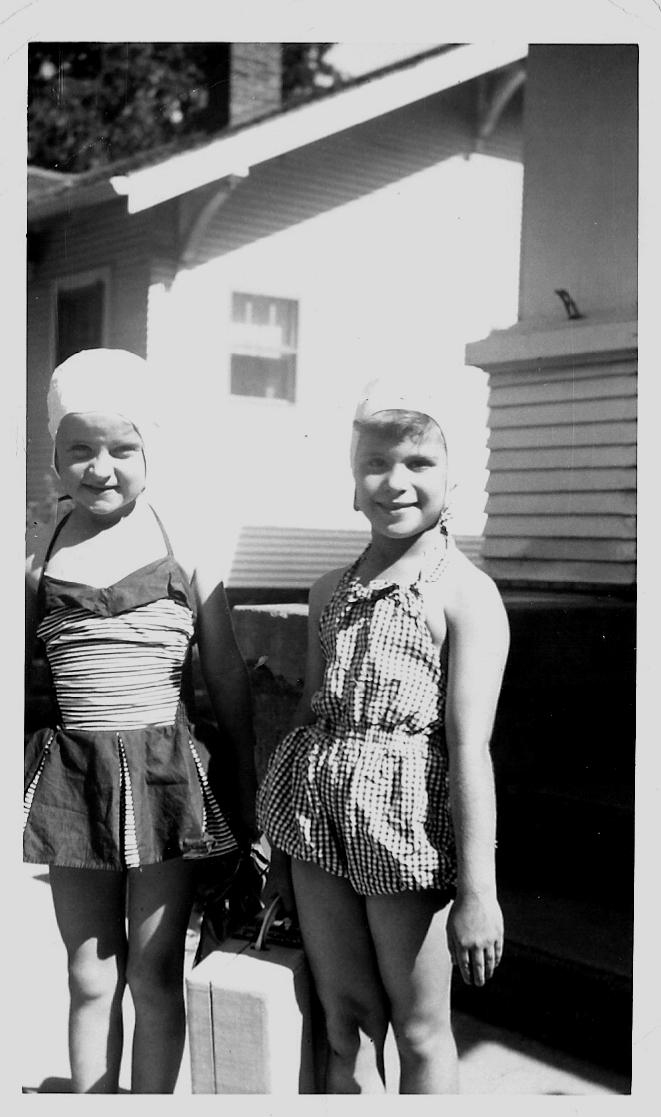
     This was the era before air conditioning in homes so most hot summer days kids gravitated to parks and pools, usually on their bikes with a round towel under their arms, flesh-colored nose plugs hanging around their necks. Girls had to wear swim caps. They were ugly, hot things and I never understood why boys didn't have to wear them too. We kids smelled like chlorine most of the summer and our bodies ripened to a bruised-peach brown and our hair turned lighter.
     At night, Aunt Florence and I would take walks, sometimes to the Dairy Queen near the college. Radio and sometimes television voices and laughter emanated from the houses we passed. One year there were swarms of cicadas. The din was a louder version of the natural ringing older people hear when there is no other sound. Thousands of empty shells clung to trees and houses or crunched under foot as you walked on sidewalks or lawns.

Chris & Bonnie head to the pool.
A friend of Aunt Florence had a daughter my age named Bonnie. She was fun, with dark, lively eyes, fierce determination and loved to laugh. What would now be labeled “play dates” were arranged and we'd either go to the park pool (alone when we were a little older), or play at her house where there were plenty of things girls were interested in. She had an older brother, Tommy, who, along with his friends, were insufferable teases.

The End of an Era
     The trips to Kearney ended after a few years. Then, I biked to our town's pool every day, or out for picnics along irrigation ditches at the edge of town with a friend. The trips to Kearney, though, made a big impression on me and may have sparked the itch to travel that grew stronger as I grew older.
     Passenger trains are long gone from our town, replaced by countless freight trains day and night. Walkable cities with neighborhood stores are being considered again. It's refreshing to see kids on bikes and playing outside, though it's often at day camps these days, where activities are organized and supervised.  
      Kids who travel today don't need a case full of distractions – they have phones or little devices to play all kinds of games - pocket-sized "toys" to keep them amused for hours on end, just like their parents.

Saturday, July 18, 2015

What Could Be Worse Than Drought or Forest Fires?

     Most of my posts lately have been about gardens and farmers' markets with photos of the abundance in both. Food, food, glorious fresh, wholesome food!
      But this week, something forced me to look at them in a different way, especially the community garden. Rather than a verdant space shared by dozens of gardeners with myriad skills and goals, it could, in a matter of horrifying minutes, become a go-to source of survival food for more than just the gardeners and their families.
      My twist of vision came with the powerful article by Kathryn Schulz in the New Yorker Magazine, titled The Really Big One; An earthquake will destroy a sizable portion of the coastal Northwest. The question is when. In it she describes a big—plus a really big—earthquake, one of which is predicted to hit the west coast within the next 50 years (or days? or minutes?). It's curious that it was in a publication more prominent on the east coast.
      People I've talked with who've read it have reacted in one of two ways: Some have since been mentally planning and physically organizing whatever preparations they feel they can make. Others shrug and say we've known a big earthquake is coming and there's nothing they can do about it so they're not going to worry about it. Yeah, but we had no idea it could be as big as Schulz describes after interviewing experts for well over a year. Am I the only one who missed the memo or report? It sure doesn't seem so by the reaction the article has garnered.
      While we have no idea how big it will be—if it will be “just” the big one, or the really big one—I'm one who feels we need to be aware and as prepared as possible. Individuals and families can prep for themselves, communities can for their neighborhoods, and governments for the even greater good. Maybe it won't be as bad out here in the country as it is in town. Maybe it will be worse. No one knows. I suspect people in rural areas would be lower on the rescue list, so it's essential to do what we can for ourselves.
Some countries where earthquakes are more common have done more to prepare than we have in the U.S. Schulz points out that most of the PNW had no seismic code until 1974, and few buildings constructed before 1994 could withstand a magnitude-9.0 earthquake today. Though I've only felt slight tremors in our 35 years here, I did experience numerous earthquakes in Latin America, one of which knocked me off my feet. Buildings were being retrofitted to minimize damage in Mexico City way back in the 1960s. Some buildings in Japan withstood the deadly quake and tsunami four years ago; quakes are more common there and they knew the worst was yet to come.
     Communities on the Oregon coast have planned for a tsunami, but if the worst-case-scenario “really big one” described in the article occurs, all the preparations in the world would do little to ensure survivability for the majority. Granted, local and state governments can do just so much to retrofit buildings and prepare for the worst now, mainly because of cost. But, the cost of clean-up and re-building would dwarf that expenditure. Still, it's hard to get people to rally around a “maybe” or even an unimaginable “probably.” When I see small children, I wonder what natural disasters they will experience in their lifetimes, well within the projected 50 years.
What Can We Do?
       That question has been eating away at me, as has the thought that at any minute I could be asking what should I have done. That's helped frame my thoughts – imagining the aftermath and saying, I wish I had... (fill in the blank). There are a lot of blanks to fill.
      At the very least I can gather supplies of water, food and everything else listed on basic websites  and create an appropriate First Aid kit. We routinely have a considerable amount of water and food stored, but would it be accessible where it's stored right now? Or will all those gallon glass jars stored on the floor in the coolest spot in the house be crushed?
      One should have basic supplies on hand in any case. In recent years I've begun to worry about forest fires raging through the neighborhood, leaving us (if not burned like crispy bacon) likely without basics such as electricity (thus the ability to pump water from our wells), communications (cell phones don't work in the “bowl” our property rests in – both a blessing and a curse) and likely blocked roads preventing us from getting out for a while, or help to get in. So, we gotta' fend for ourselves. It's during power outages that I'm most grateful we have a compost toilet.
      But, where should one store supplies? In a house that might collapse or burn? Buried in the woods where trees can burn or fall on it? In an open field where it will deteriorate faster? Where might the ground “open up”? At the moment, I'm thinking stashes in various places would be best.
      The time of year a quake hits will also alter needs, especially in clothing and shelter. Would our woodstove be accessible if it hits in winter? Would it be safe to use? Would it be safe to go into the house even if it looks ok, but everything inside has been tossed about, including heavy furniture and appliances? Would nearby streams be full and running at that time of year?
      We used to have medical professionals in the neighborhood – an ER doc and a nurse. Both have moved away. What talents, skills or people trained in crisis response live among those new to the neighborhood? We used to know most of the neighbors, or at least of them. I regret that I don't know many of the new people. Will we meet under panicked circumstances? One can only imagine the stories to be told decades after the event about the surprising things you learned about the neighbors you do know – and those you don't.
      Back to the community garden. Depending on the time of year and amount of devastation, community gardens everywhere could be wiped clean as quickly as grocery stores would be. There would be no farmers' market that week - or for many, many months or years to come. In fact, food getting in from the outside could be impossible - or at the very least, very difficult, for some time.
      Experts, such as paleoseismologist Chris Goldfinger of OSU estimate a 1 in 3 chance for the “big one” to occur within the next 50 years and a 1 in 10 chance that the really big one will, according to Schulz's article.
      How lucky are you feeling today?


Tuesday, July 14, 2015

Whoa! Our gardens thinks it's August already, as does just about every plant that relies on nature for its water, such as those in forests. But gardens, fortunately, can rely on humans for their water when Nature is on vacation. But there is a mini-forest or two in our community garden (and home gardens) of "lettuce trees" stretching skyward, just like a tree, about to go to seed. 

They look odd, but I think they're quite amazing. And even more amazing are the little seed companies who encourage you to save your own seed and tell you how to do it. Adaptive Seeds is one example, Wild Garden Seed is another (Frank Morton's essays are always enlightening too). Don has saved seed from plants grown from seeds bought from both companies and had good success the following year with them.


 I love the rich color of this lettuce, set off by all the shades of green surrounding it. It probably has "vino" or "wine" in its name.


    These are closer to seeding.

     Sometimes when you go by farms, such as Gathering Together, where many Wild Garden seeds are grown (the rest at Frank and Karen Morton's farm, Shoulder to Shoulder, in Wren), you think the farmer has gone on vacation and just "let everything go." There is art and science that goes into growing plants for seed commercially, requiring good timing, cleaning, labeling, and storage. If you think it's easy, try saving seed from various crops in your garden, especially a variety of greens, and discover just how easy it is to get them mixed up.


     Someone harvested the garlic they planted last fall and is letting it air dry. You can't see them, but there are seeds on top of them as well, since the scapes weren't cut off. The tops can go to "bulblets" which can be planted next season. We've planted them as bug and rodent deterrent. I don't know the process for growing more big garlic bulbs from them, if it is possible, but suspect it would take a few seasons.


    Someone's onions are ready to harvest. They look like the mild summer ones. Yum!


    A great corn crop in a new raised bed where the big compost pile used to be. Good soil under there!


Artichokes, the "grande dames" in their colorful finery


    Lots of squash are fruiting now (besides zucchini). These spaghetti squash look like they're gossiping about the other plants in the garden.


    A lovely melon peeks out from its protective leaves and vines. This is a good year to grow melons.


    Tomatillos plus....


    ...peppers = great salsa verde!


All trellises are getting leaned on pretty hard now


as are the sturdy stalwarts


     Oops! Looks like somebody is on vacation...


But the deer aren't - they've been nibbling on my bean plants. Time to drag out the bird/deer netting again. Aaaaarrgh!!


   Delicate blossoms about to respond to the sun


    To me, zinnia buds are even more intriguing than the flowers themselves.

    Thank you to all my community garden neighbors who grow flowers - what I call "gardening for the soul." I am one of many who really appreciate and enjoy them.

Sunday, July 5, 2015

And the Winner Is....

   (Rant alert!)
    Oh, there are so many candidates for the Darwin Award in our neighborhood. Just when you think that "surely they wouldn't...," evidence proves otherwise.
    The 4th of July is a good example. Every July 4th and New Years Eve you hear guns and fireworks out here. New Years Eve doesn't worry me so much since we've usually had rain and there isn't likely much dry grass to catch fire. But, on the 4th of July there sure is - and this year there's more than usual, given we've just finished the hottest, driest June on record and haven't seen (nor do we expect) a drop of rain in July. Foresters and farmers say we're at least a month ahead in dryness and crop development. The Forest Service's sign on Hwy 30 lists fire danger at HIGH. Scary.
     Surely, the neighbors wouldn't be stupid enough to shoot off fireworks, my neighbor and I thought. Well, I wasn't the only one who went to bed knowing right where her clothes were in case we had to evacuate in the middle of the night because of a fire. I should give the nincompoops (that's my polite name for them) credit for making me think ahead about what I'd grab if evacuation were necessary. Family in central Washington had to evacuate one night last week when fire swept through their neighborhood (human caused, it turns out).
Our property between here (Starkers) & tall trees in distance
The closest fireworks this 4th of July happened a 2-minute walk through our forested neighborhood from our house to theirs. To give credit where it's due, they were lighting them on the driveway, which is better than on the dry grass of their yard, just paces away. Never mind that their wood house, garages and at least 2 gas vehicles were as close as the dry grass, some closer. Neighbors in wood houses, a field of dry grass across the road, barns, forests all could easily have gone up in flames, along with numerous pets and wild animals. But then these are the people said to have been shooting their guns towards the road a couple months ago. Welcome to the neighborhood!
  
     Throughout the summer the sound of motorbikes and ATVs in Starker's Evergreen forest across the road sends chills down my spine. The grass is dry and tall, not just along the road (where they've also sprayed trees and brush, adding to the flammables), but in the middle of the road itself. Starker's naturally closes the property to everyone when things get really dry in the summer, but that doesn't stop some neighbors from taking their ATVs, guns and motorcycles in. (It amazes me Starker's lets any of us go in the rest of the year, even with permits).

Road in Starker Forest across the road from us
      When I confronted one neighbor about it a couple of summers ago, he insisted he had permission to be there "because he's a neighbor"  and, besides, he has spark inhibitors on his motorcycle. I checked with Starkers and they said NO one has permission to use motorized vehicles there in summer. When I told the woman who answered about the "spark inhibitors" she laughed. "It won't prevent hot metal and fumes from igniting dry grass as it passes over it," she said. 
     Then there are the cigarette butts I've seen on these logging roads... They're on the main roads too, which is scary enough, but on a logging roads where people go (supposedly) to get exercise?

     It's not surprising that there is tall grass among the young trees in this area that was clear-cut, then replanted just a few years ago. That's the cycle. Once the trees grow tall, they'll shade out grass and blackberries. 'Til then, it behooves everyone to be careful and obey the signs that say no fires and no motorized vehicles.
      I fear it's going to be a long, hot, dry summer, giving the Darwin candidates ample time to "win" their seemingly-coveted award. I just don't want our property to go up in blazing glory with them.